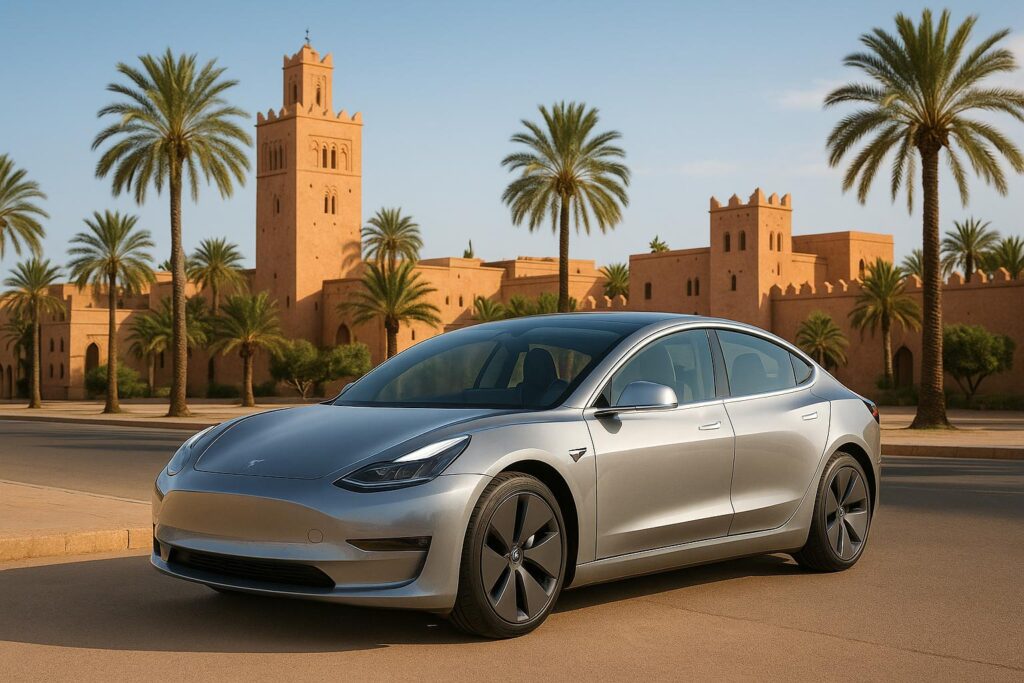
As the leading electric vehicle manufacturer seeks to broaden its global footprint, Morocco’s strategic location—serving as a gateway to both Europe and the Middle East—positions it as an ideal market for automotive expansion. The country has rapidly evolved into a thriving automotive hub, attracting major international players. For instance, French automaker Renault established a factory near Tangiers, while Stellantis recently announced a €1.2 billion investment to expand its Kenitra plant, enhancing production capacity. These significant foreign investments have solidified Morocco’s role as a crucial supply chain hub for the European and Middle Eastern markets, making it a natural choice for Tesla’s African debut.
While Morocco’s strategic location plays a significant role in its appeal, it is not the sole factor driving its attractiveness to investors. The Moroccan government has been pivotal in creating a favourable business environment through proactive policies and direct financial support. Offering subsidies of up to 35 per cent, the government has successfully incentivised companies seeking to outsource production to a more cost-effective and efficient setting. Additionally, the streamlined regulatory process allows for the approval of new factories in as little as five months, making Morocco an exceptionally attractive destination for automotive and manufacturing investments.
“We didn’t export one car 15 years ago. Now it’s the first exporting sector in the country, “Ryad Mezzour, minister of Industry and Trade told AP in an interview.
Tesla’s interested In Morocco
The automotive industry is a cornerstone of Morocco’s economy, accounting for 22 per cent of the country’s total GDP and producing over 700,000 vehicles annually from its state-of-the-art factories. With export valued at $14 billion each year, automobiles have become Morocco’s number one export sector. As these impressive figures continue to rise, so does the country’s growing focus on electric vehicles (EVs). This trend has attracted significant global attention, including from industry leaders like Tesla. Recognizing Morocco’s competitive manufacturing ecosystem, strategic location, and supportive government policies, Tesla has shown increasing interest in establishing a presence in the country to capitalise on the expanding EV market and Morocco’s ambitions to become a regional hub for sustainable automotive production.
Tesla officially established its subsidiary, Tesla Morocco, on 27 May 2025, with an initial investment capital of MAD 27.5 million (approximately USD 2.75 million). As part of its commitment to supporting the country’s growing electric vehicle market, Tesla has begun deploying hybrid supercharger stations in key cities including Casablanca, Tangier, Rabat, and other strategic locations. This move not only enhances the EV infrastructure across Morocco but also underscores Tesla’s confidence in the country’s potential as a vital hub for sustainable transportation in the region.
Growing trend in adoption of EV
The adoption of electric vehicles (EVs) in Morocco is experiencing a remarkable surge. By the first half of 2025, EVs captured a 3 per cent share of the total automotive market, representing an impressive 176 per cent growth compared to the previous period. Throughout the year, leading EV manufacturers also reported significant gains: BYD’s sales soared by 407 per cent, Citroën’s increased by 95.9 per cent, and Dacia’s grew by 113.4 per cent. This accelerating trend highlights Morocco’s rapidly evolving EV landscape. Tesla’s strategic investment in the country underscores its commitment to expanding its presence in the region, positioning Morocco as a crucial gateway into both the African and Middle Eastern markets. By capitalising on this burgeoning demand for electric mobility, Tesla aims to play a key role in driving the future of sustainable transportation across these emerging markets.
The future of Tesla and EV
The EV industry is gaining significant momentum, supported by strong government backing and a favourable environment for the automotive sector as a whole, paving the way for a positive market outlook. Demand for EVs is rising steadily across the entire value chain, reflecting growing consumer and business interest. Moreover, there is a vast market opportunity for EV sales extending beyond Morocco to Europe, the Middle East, and Africa at large. Tesla is strategically betting on this potential, recognising the exponential growth prospects and showing no signs of yielding ground to other EV manufacturers eager to claim market leadership.