Saudi Arabia’s NEOM posted a terse but telling message on X: “Europe- Egypt- NEOM- GCC: your faster route.”
Accompanied by a map, the post traced a corridor linking Europe to Egypt’s ports of Damietta and Safaga, on to NEOM Port, then overland to Kuwait, Iraq, Bahrain, Qatar, the United Arab Emirates and Oman.
It was not a routine update. It signaled that a long-discussed trade route is now operational.
That same day, the Public Investment Fund approved its 2026-2030 strategy, outlining Saudi Arabia’s economic path to the end of the decade. NEOM said it “remains a central pillar” of that transformation, with its designation as an independent system underscoring official commitment.
The timing indicated clear alignment between the port’s rollout and the broader national strategy.
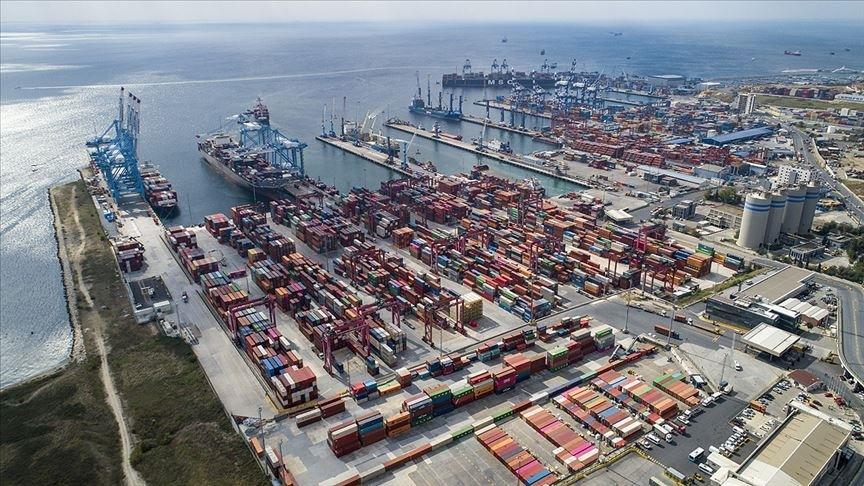
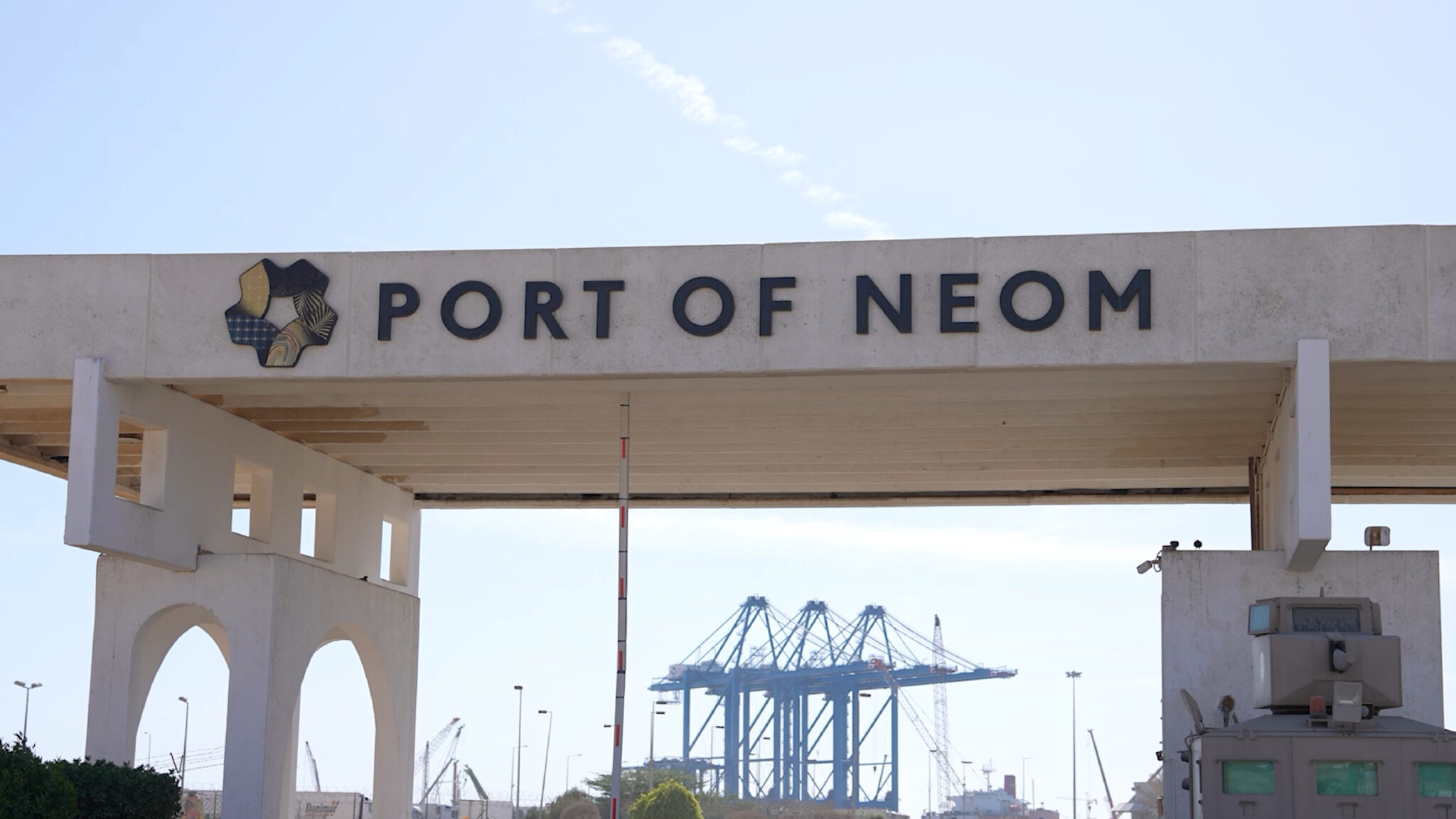
On the ground, progress is moving fast. The main container terminal, built to handle the world’s largest ships, is set to open this year with a capacity of 1.5 million twenty-foot equivalent units.
In June last year, the port received its first fully automated, remotely operated cranes, the first in the Kingdom, in what officials called a milestone for Saudi ports.
In a recent update, NEOM said the port is already operating at full capacity as a Red Sea hub, handling multiple cargo types, supported by advanced infrastructure and high operational standards. It links trade flows from the Americas, Europe and Egypt to Gulf and Iraqi markets.
A new logistics map
Abdullah Abdulrahim Almeer, an assistant professor at King Fahd University of Petroleum and Minerals and a member of the Saudi Economic Association, said NEOM’s location gives it an edge.
Unlike major Saudi ports clustered on the western coast or in the Gulf, NEOM sits at the far northwest, where Europe, the Gulf and northern neighbors converge.
He said the port can act as a “bridge port,” linking the sea and land into a single system. Its proximity to the Suez Canal and its road links to Jordan, Iraq and Gulf states strengthen its role as a future logistics hub.
“NEOM Port is not just competing with Jeddah or Dammam, it is opening a new axis that reshapes regional logistics,” he said, citing tensions in routes such as the Strait of Hormuz.
Logistics consultant Nashmi Al-Harbi said the port complements, rather than competes with, existing Saudi ports. He added that its reliance on renewable energy boosts efficiency and positions it as a sustainability leader.
Faster, leaner supply chains
Almeer said the corridor can cut shipping times by more than half. Cargo that once took 10 to 12 days to reach Gulf destinations can arrive in 4 to 6 days by combining short-sea routes with fast overland transport.
The gains come not just from distance, but from reduced waiting times, simpler procedures and less congestion.
Al-Harbi said the corridor “revolutionizes supply chain efficiency,” offering a reliable alternative amid geopolitical uncertainty.
Both said time-sensitive goods stand to gain most, including fast-moving consumer goods, fresh and refrigerated food, pharmaceuticals, spare parts, high-value electronics and advanced construction materials.
From the trial phase to the real trade
Almeer said the port has moved beyond early testing and can now support real trade flows, though it is still scaling up. He expects it to become a major regional hub as expansion continues.
Al-Harbi said the port reached an advanced operational stage in 2026, with infrastructure capable of handling regional trade, supported by advanced digital systems, automated cranes and modern road links.
Almeer pointed to the involvement of major firms such as Bahri and DFDS as evidence that global players have shifted from watching to operating, though the port is still proving itself at scale.
Al-Harbi said the interest reflects a search for safer, more reliable routes amid disruptions to global supply chains.
Driving diversification
Almeer said the Public Investment Fund’s strategy puts logistics at the heart of economic diversification. NEOM Port and the corridor directly support that goal, linking Europe, Africa and East Asia to Gulf markets by land and sea.
Supporting measures include exemptions from storage fees for up to 60 days, allowing Gulf trucks to enter empty or loaded, and launching regional storage and redistribution initiatives.
He said the impact on Tabuk will be significant, creating direct jobs in port operations and indirect roles in transport, warehousing and logistics, while opening the door for new industrial zones.
NEOM’s location near Iraq, Jordan and Kuwait strengthens its role as a regional gateway, he said, boosting Tabuk’s appeal and placing it at the center of regional and global trade.